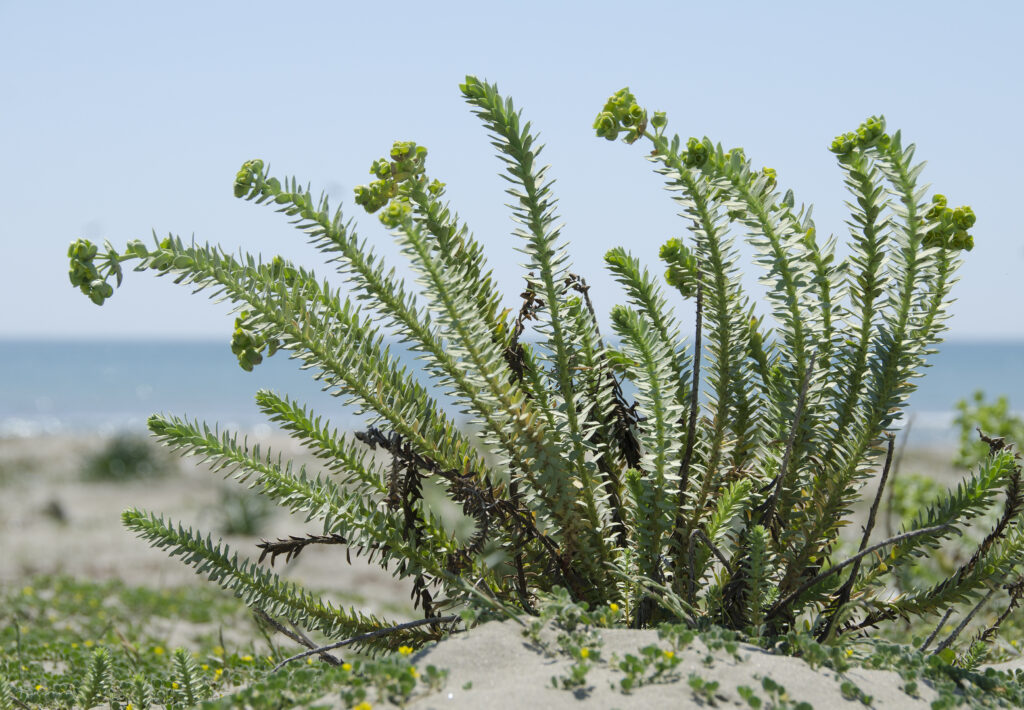
Invades coastal areas. Decreases available nesting sites for the Hooded Plover. Exudes a caustic milky sap which can harm skin and eyes.
Photos from SGLN’s 2017 weed guide
About Spurge – Sea
Euphorbia paralias invades coastal dunes. A perennial herb to 90 cm with long taproot and clusters of yellow-green cup like flowers borne on ends of longer stems. Poisonous when damaged, plants exudes a caustic milky sap which can harm skin and eyes. Fruit consists of green, hairless oval capsules to 5 mm. Seeds spread by ocean currents and wind.
Manual control
Always wear gloves and glasses when hand pulling.
From SGLN’s 2017 weed guide.
Herbicides must be applied at the appropriate rate as specified on the label and all safety precautions followed. If chemical control is necessary near drainage lines or streams, use extreme caution as the effects on aquatic life can be devastating even in minute amounts. Always seek expert advice.
Chemical control notes from SGLN’s 2017 weed guide
A number of herbicides have been successfully used to control sea spurge, including glyphosate and metsulfuron-methyl. Advantages of using herbicide control include the potential for controlling much larger infestations. Herbicide treatment may also be an advantage where manual removal poses a problem, such as Aboriginal midden sites. Disadvantages include potential damage to off target species and windy conditions typical of coastal sites making herbicide application more difficult. Foliar spraying is the preferred herbicide application method for the control of large sea spurge infestations. Backpack spraying allows for larger areas to be treated than with hand removal, although some regrowth can be expected. Therefore follow-up treatment will be important. The cut and paste control method for sea spurge is highly effective on individual plants. Always check the herbicide label before use.
These notes are from 2017, and some information, particularly herbicide information, may be out of date. Please ask local suppliers and do your own research in selecting herbicides if choosing chemical control.
Family, origin, type, plant instead, control methods and the note above are from SGLN’s pocket guide Common weeds of South Gippsland (2026).