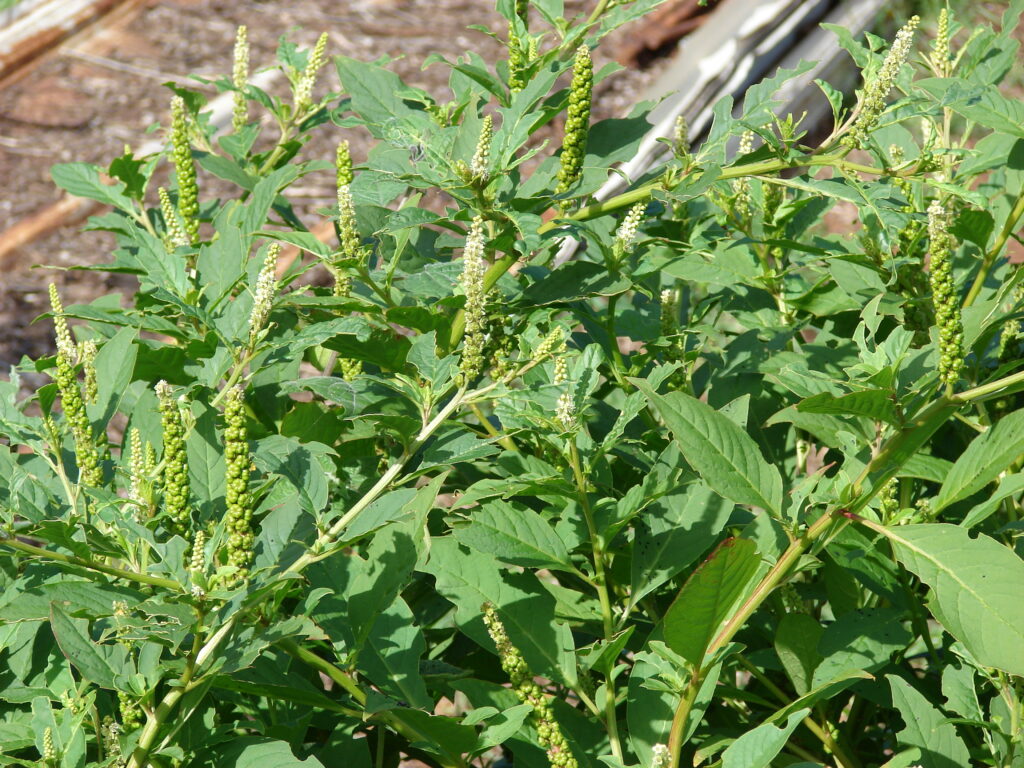
Phytolacca octandra is a short lived perennial, woody-based, hairless herb to 2 m high and sometimes tinged with red. The oval leaves are 4-25 cm long. It has several spikes of small greenish white flowers. The flowers have 5 petal-like sepals each 2.5-4 mm long. There are 7-10 stamens and 8 styles. The fruits are reddish black succulent berries and produce red juice (ink) when ripe and crushed. It has a somewhat tuberous taproot and long thick lateral roots. Native to tropical America, Inkweed is now a weed of roadsides, creek lines, poorly-managed pastures and waste land where it is readily spread by birds. It flowers mainly in spring and summer. It contains a number of toxic compounds.
Manual control
Drag a railway iron or similar across heavy infestations to uproot the plants. Cut the roots about 50 mm below ground level with a mattock to control isolated or remaining plants. Cultivation with discs is also effective. Seedlings may be manually removed but older plants tend to break off and regrow unless cut below ground level with a mattock.
From SGLN’s 2017 weed guide.
Herbicides must be applied at the appropriate rate as specified on the label and all safety precautions followed. If chemical control is necessary near drainage lines or streams, use extreme caution as the effects on aquatic life can be devastating even in minute amounts. Always seek expert advice.
Chemical control notes from SGLN’s 2017 weed guide
In open areas, a blanket wiper applying 1 L glyphosate(450g/L) in 2 L water can be used. Small infestations may be treated with 100 mL Tordon®75-D in 10 L water. This will control existing plants and has residual activity for control of seedlings. Larger infestations can be controlled with 50 g/ha metsulfuron (600g/kg) or 1 g in 10 L water for hand spraying. Half these rates will control seedlings. If surrounding areas are infested, seedlings will need to be controlled annually wherever birds roost. Always check the herbicide label before use.
These notes are from 2017, and some information, particularly herbicide information, may be out of date. Please ask local suppliers and do your own research in selecting herbicides if choosing chemical control.