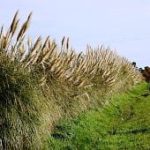
Known to cause cattle deaths in spring due to cyanic compounds present in non-flowering plants.
Photos from SGLN’s 2017 weed guide
About Sweet Reed Grass
Glyceria maxima is a robust perennial grass native to Europe that grows 90-250cm in height. Leaves are bright green, 30-60cm long. Leaf blades are flat with a prominent midrib and rough margin. Flowers appear in spring in many branched 15-45cm long panicles. Roots are fibrous, growing from nodes on the rhizomes and may reach a depth of 1 metre. Previously known as Poa aquatica. Infestations in dams and waterways will affect water quality, choke out other desirable species and can cause cyanide poisoning in stock.
Manual control
This plant can be removed by hand or mechanical means but any rhizomes left behind will re grow. Covering with black plastic can achieve 100 per cent control. This may be suitable for small infestations where the plastic can be securely fixed in place.
From SGLN’s 2017 weed guide.
Herbicides must be applied at the appropriate rate as specified on the label and all safety precautions followed. If chemical control is necessary near drainage lines or streams, use extreme caution as the effects on aquatic life can be devastating even in minute amounts. Always seek expert advice.
Chemical control notes from SGLN’s 2017 weed guide
Spring through to summer when it is actively growing. Chemicals to use are Round Up Biactive. Always check the herbicide label before use.
These notes are from 2017, and some information, particularly herbicide information, may be out of date. Please ask local suppliers and do your own research in selecting herbicides if choosing chemical control.
Family, origin, type, plant instead, control methods and the note above are from SGLN’s pocket guide Common weeds of South Gippsland (2026).