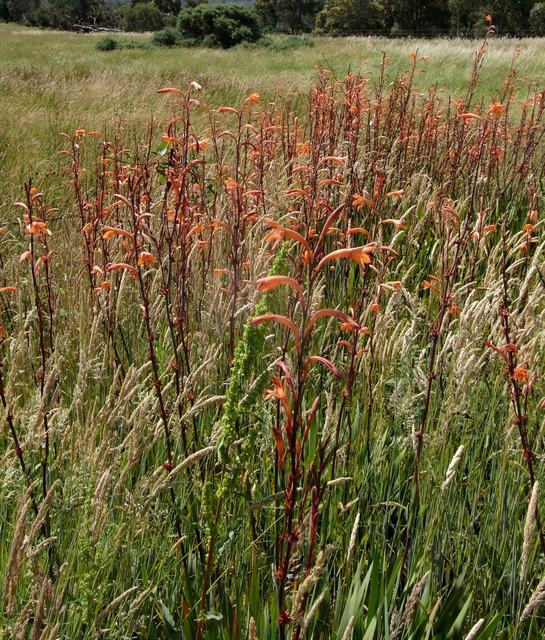
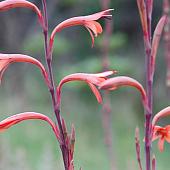
Watsonia meriana var.bulbillifera is an erect perennial herb to 2m. Basal linear/Sword-shaped leaves up to 0.6m long with distinct midrib are arranged in a fan-like formation. Above ground parts dieback to underground corm each autumn. Curved trumpet shaped salmon pink to orange red flowers formed solitary in spike inflorescences on tall reddish unbranched stems in spring-summer. No seed set, but small bulbils are produced in clusters of up to 16 along the stem below the flowers. Globular corm. 1-3 new corms produced each growing season. Roots, bulbils and corms spread by water, humans, contaminated soil (earthmoving equipment, car tyres etc) and garden refuse dumping.
Manual control
When manually removing all bulbils should be removed. This is difficult. Hand dig, ensuring all corms are removed. Extensive follow-up required. Remove and bag all bulbils.
From SGLN’s 2017 weed guide.
Herbicides must be applied at the appropriate rate as specified on the label and all safety precautions followed. If chemical control is necessary near drainage lines or streams, use extreme caution as the effects on aquatic life can be devastating even in minute amounts. Always seek expert advice.
Chemical control notes from SGLN’s 2017 weed guide
The registered chemical is Amitrole-T. Some success can be achieved using Brush Off, Round Up and Pulse pentetrant mix. Re-treatment will probably be required. Always check the herbicide label before use.
These notes are from 2017, and some information, particularly herbicide information, may be out of date. Please ask local suppliers and do your own research in selecting herbicides if choosing chemical control.
Family, origin, type, plant instead, control methods and the note above are from SGLN’s pocket guide Common weeds of South Gippsland (2026).