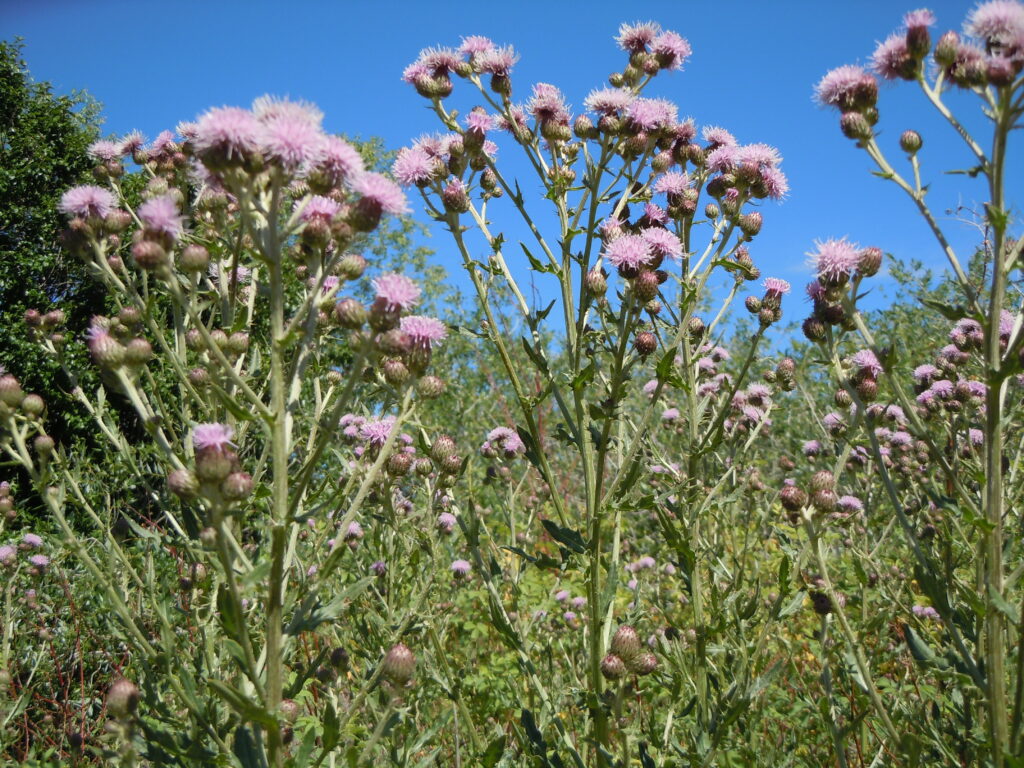
Cirsium arvense is an erect perennial thistle with a creeping rootstock. The leaves are very dissected with spiny margins and white hairs underneath. Heads of round purple-pink flowers appear in summer followed by seeds attached to hairs. Reproduces from seed, creeping roots and rhizomes. Californian thistle prefers sub-humid to humid, cool temperate regions where it occurs in open, moderately-warm situations up to sub-alpine levels. In Australia, it is generally confined to pastures, cultivated crops, roadsides and neglected sites. Although it is more vigorous in the wetter areas where rainfall exceeds 750 mm, Californian thistle is capable of growing in drier areas and can adapt to most soil types.
From SGLN’s 2017 weed guide.
Herbicides must be applied at the appropriate rate as specified on the label and all safety precautions followed. If chemical control is necessary near drainage lines or streams, use extreme caution as the effects on aquatic life can be devastating even in minute amounts. Always seek expert advice.
Chemical control notes from SGLN’s 2017 weed guide
This thistle tends to appear later in the season than other thistles normally seedlings appear around December flowering March onwards, spraying is effective through this period. Chemical Lontrel is the registered and most effective due to the long deep root system. Always check the herbicide label before use.
These notes are from 2017, and some information, particularly herbicide information, may be out of date. Please ask local suppliers and do your own research in selecting herbicides if choosing chemical control.
Family, origin, type, plant instead, control methods and the note above are from SGLN’s pocket guide Common weeds of South Gippsland (2026).