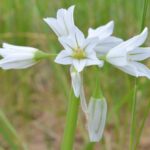


Agapanthus is a genus of herbaceous perennials that mostly bloom in summer. The leaves are basal, curved, and linear, growing up to 60 cm long. They are rather leathery and arranged in two opposite rows. The plant has a mostly underground stem called a rhizome that is used as a storage organ. The roots, which grow out of the rhizome, are white, thick and fleshy. The flower head is a pseudo-umbel subtended by two large bracts at the apex of a long, erect scape, up to 2 m tall. They have funnel-shaped or tubular flowers, in hues of blue to purple, shading to white. Able to tolerate salt spray, agapanthus readily grows on foreshores. The plant also tolerates drought, light frosts, fire and some degree of waterlogging.
Manual control
Hand dig, bagging all plant parts and removing from site. Remove spent flowers in mid-late summer to prevent seeds forming as a means of confining agapanthus to gardens.
From SGLN’s 2017 weed guide.